
Low-Impact Plyometric Exercises Seniors Love
By E5Fit Editorial Team · Updated 2026-07-23
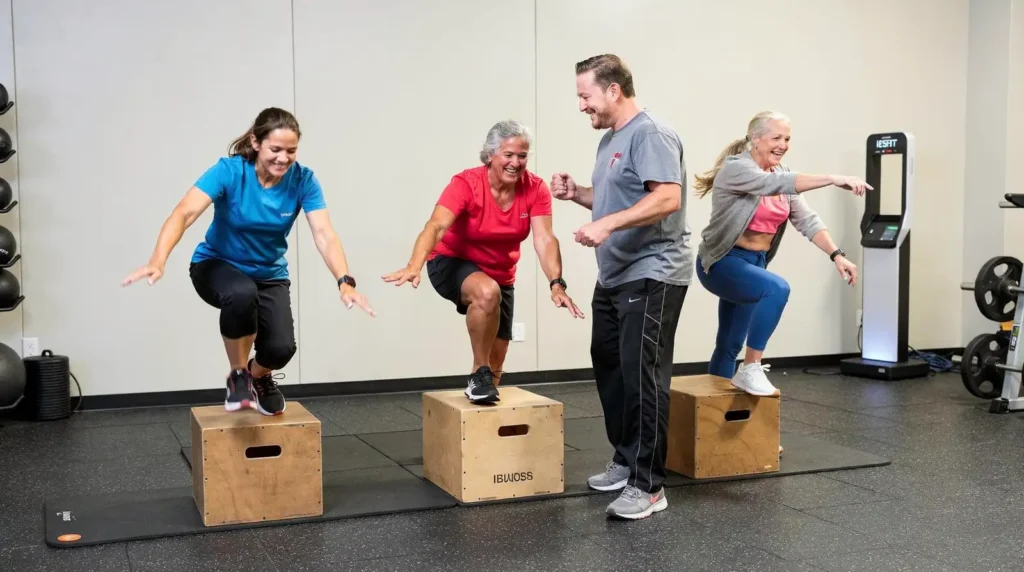
Low-impact plyometric options for adults over 40 include pogo hops, lateral step-overs, and box step-downs, which build power while limiting joint stress. A pogo hop keeps the knees soft and the ankles doing most of the work, teaching the tendons to absorb and return force quickly without a heavy landing. A lateral step-over trains change-of-direction control, the kind of stability that protects the knees and hips during everyday movement like stepping off a curb or turning quickly. A box step-down builds eccentric strength in the quads and glutes by controlling the descent rather than dropping into it, which is often the missing piece for adults who feel confident jumping up but unstable landing down.
Coaches at E5FIT scale these movements based on neuromuscular control and joint tolerance, following approaches outlined by Alloy Personal Training research on plyometrics for the 40+ population, protecting knees, ankles, and hips during progression. Scaling means adjusting amplitude, surface, and rest between reps before ever adjusting intensity, so the body earns the right to progress rather than being pushed into it.
Key Takeaways
- Plyometric training improves explosive power, agility, and performance for adults over 40 effectively.
- Low-impact plyometrics support bone health and strength development critical for longevity.
- Tina Tang deadlifted 310 pounds at 52 through consistent plyometric and strength training.
- E5Fit’s Atlanta-based trainers design personalized plyometric programs specifically for the 40+ demographic.
What Should You Know Before Starting Plyometrics After 40?
Readiness for jump-based training after 40 depends on baseline strength, joint tolerance, and a structured entry point rather than diving straight into box jumps. E5FIT built its programming specifically around this age group, understanding that power training for adults over 40 carries different demands than a 20-something’s routine.
Why does aging change how the body handles jump training?
Aging brings a progressive decline in neuromuscular function: the nervous system recruits muscle fibers more slowly, reaction time lengthens, and fast-twitch fibers, the ones responsible for quick, powerful movements, shrink faster than their slow-twitch counterparts without targeted training. That decline raises fall risk, weakens fracture resistance, and can chip away at daily independence, from climbing stairs confidently to catching balance after a stumble. Jump training over 40 addresses this decline directly by asking the nervous system to keep producing fast, coordinated force, but only when introduced with the right sequence and supervision so tendons and joints have time to adapt alongside it.
Before adding plyometric exercises for seniors to a routine, three steps matter:
- Schedule an individualized assessment through 1-on-1 Personal Training so a coach can evaluate joint mechanics and strength baselines before any jumping begins.
- Start with a small, approachable volume of jumps rather than a full plyometric circuit, letting tendons and connective tissue adapt gradually.
- Test the programming without a long-term contract, since E5FIT requires none, allowing clients to gauge how their knees, ankles, and hips respond first.
Does low-impact plyometric work still count as real training?
Yes. Scaled, supervised jump work still builds the explosive power that counters age-related neuromuscular decline. The intensity matters less than consistency and proper progression.
How Do You Perform Low-Impact Plyometrics Safely?
Safety starts with supervised progression, not intensity. Coaches at E5FIT use a Small-Group Personal Training format, keeping class sizes small enough to watch jump mechanics closely. Close supervision matters most in the early weeks, when joints and connective tissue are still adapting to new demands.
Power training for adults over 40 follows a clear sequence rather than jumping straight into box jumps or depth drops:
- Master a soft-landing squat pattern before adding any hop.
- Progress to small, low-amplitude hops in place.
- Add lateral and forward hops once landings stay quiet and controlled.
- Introduce single-leg variations only after double-leg patterns feel stable.
Why Does Plyometric Training Matter for Bone Health?
Bone density often declines quietly, even in clients who lift heavy and eat well. Strength training builds muscle and applies steady mechanical load, but bone responds most to brief, high-rate impact forces, the kind a jump produces and a squat or deadlift does not. Plyometric exercises for seniors supply that impact-based loading that strength training alone doesn’t replicate, filling a gap many well-rounded routines miss.
This matters most for adults over 40, since bone density naturally trends downward with age, and the decline accelerates further after menopause in women. Ground-reaction forces from even modest hops signal bone-building cells to stay active, which is why E5FIT treats low-amplitude jump work as a standing part of programming rather than an optional add-on. Paired with adequate protein intake and progressive strength work, that impact loading gives bone tissue a reason to maintain, rather than shed, density over time.
Do You Need High-Intensity Jumps to Build Power?
No. Jump training over 40 works through lower-impact, efficient movements rather than aggressive moves like cleans or snatches. E5FIT trainers guide clients through this progression in a supportive setting. Precision Nutrition Level 1–certified coaching addresses recovery and tissue health that supports the process from the inside out.
What Mistakes Should You Avoid With Jump Training?
Three errors undermine most jump-training efforts for adults over 40. The biggest one: avoiding jumping altogether. Many active adults assume plyometric exercises for seniors carry automatic joint risk, a belief fueled by unsubstantiated claims rather than actual evidence. That avoidance costs strength, power, and bone stimulus that other exercise forms simply cannot replicate.
Is skipping progression a common mistake in power training?
Rushing into advanced box jumps or depth jumps without a structured build-up sets adults up for setbacks, since tendons and connective tissue adapt far slower than muscle does, often taking many weeks longer to strengthen even when the muscles feel ready. Jump training over 40 requires programming that respects those tissue adaptation timelines, sequencing amplitude and complexity in small increments rather than leaping from a soft double-leg hop straight to a single-leg depth jump. Honoring the nuances of exercise progression, not a one-size-fits-all leap into intensity, is what separates sustainable power gains from an overuse injury waiting to happen.
Why does training alone increase risk during power development?
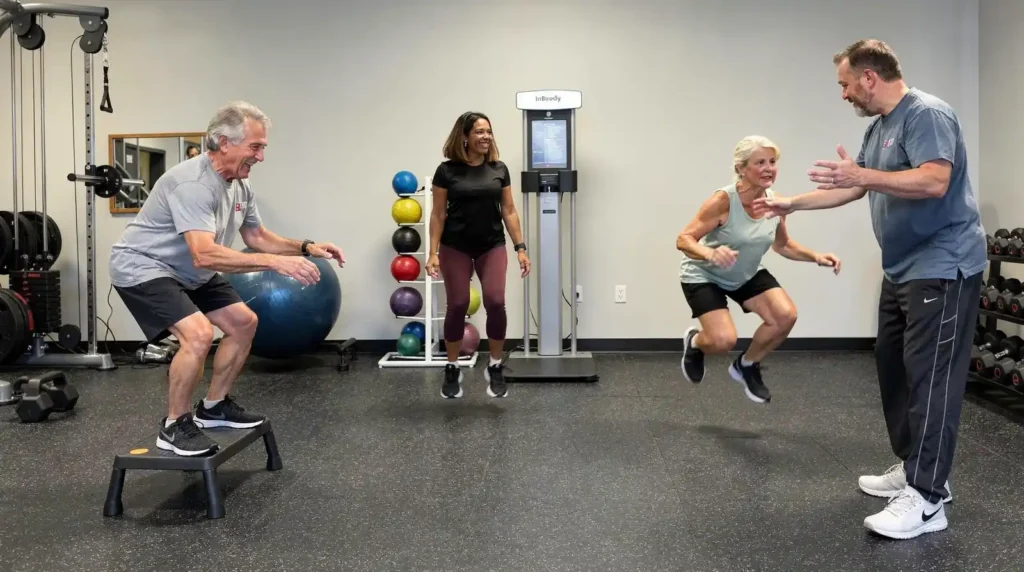
Solo practice removes the real-time feedback that catches faulty landing mechanics before they become habits, things like a knee caving inward, a heavy heel strike, or an asymmetrical push-off that a mirror rarely reveals but a coach’s eye catches immediately. Left uncorrected, those small compensations compound over repeated reps and become the pattern the body defaults to under fatigue, precisely when injury risk is highest. Group accountability keeps effort and form honest, since training alongside others adds both the coaching cues and the social motivation to show up consistently, which matters as much as any single workout for long-term progress.
Common missteps include:
- Avoiding jump work entirely out of unfounded joint concerns
- Skipping foundational strength work before adding plyometrics
- Jumping straight into high-intensity variations without progression
- Training in isolation, without coaching eyes or peer accountability
E5FIT, based in Buckhead, Atlanta, addresses these gaps directly. Its five-person coaching team stays small by design, allowing closer oversight of technique during power training for adults sessions. The studio’s community-driven model leans on group motivation and shared energy, replacing isolated guesswork with structured, supervised, and socially reinforced practice.
FAQ
Do adults over 40 need high-intensity jumps to build power?
No. Jump training over 40 works through lower-impact, efficient movements like pogo hops and step-overs that build explosive power without requiring maximal-intensity jumps.
How does E5Fit keep low-impact plyometrics safe for this age group?
E5Fit uses Small-Group Personal Training with small class sizes. Coaches watch jump mechanics closely, plus individualized 1-on-1 assessments to evaluate joint mechanics before jumping begins.
Can someone try E5Fit's plyometric programming without commitment?
Yes. E5Fit requires no long-term contracts, letting clients test how their knees, ankles, and hips respond to the programming before committing further.
Conclusion
Low-impact plyometrics for adults over 40—pogo hops, lateral step-overs, and box step-downs—build explosive power while limiting stress on the knees, ankles, and hips through scaled amplitude and supervised progression. E5FIT’s Small-Group Personal Training format pairs individualized assessment with close coaching oversight, so jump mechanics stay sound as tendons and connective tissue adapt at their own pace. Beyond power and agility, this style of training supplies the impact-based loading that supports bone density, a benefit strength training alone doesn’t fully replicate. For adults ready to add joint-friendly jump training to their routine, E5FIT’s no-contract programming offers a low-risk way to start.